torstai 24. maaliskuuta 2016

The Ryuken time


Since I was defeated by my ex-student and team partner Ricky Vendetta at the Winter War wrestling show last Saturday, I decided to point out a few details of what happened that evening. I guess in the end of the day it was the heat of the challenge that gave Ricky the extra edge to overcome the serenity I hold as strength thanks to my experience - to Ricky it was not just another match, whereas I've been in the very situation many times before. So I can now look at it as a chance to re-learn some of the martial art teachings I haven't had my mind set on recently.

Instead of a typical lock up I chose to apply: a bit of Dumog kind of approach for starters. See how I claim the arm, and note the strong stance - clearly different from that of Ricky's.

You might think one prefers to stand taller than the opponent, but I'm going lower istead. I want to make sure he doesn't pull me over, and I can see the influence of Japanese swordmanship there as well.

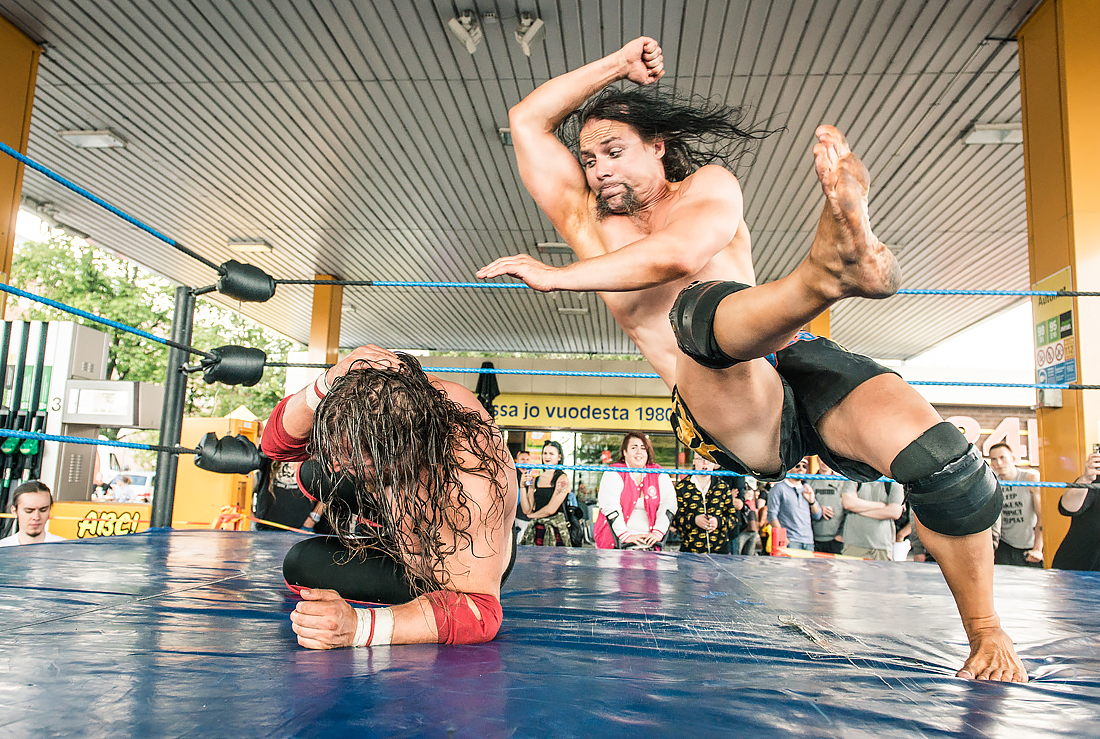
When there's not much distance the front kick is sometimes either a "scrape" or simply weak. Not in my case. I bring the knee high up and drive the foot forwards in a stomp-like manner. This I learned from the ninjas of Togakure ryu.

They often expect the clinch but one can also go reverse: "The dragon whips with its tail", said Bruce Lee.

I thought Ricky Vendetta couldn't surprise me in the ring but he did (well at least he's standing outside). An intelligent move to first retreat and then quickly strike while I'm feeling confident.

A variation of chin lock where he's grabbing the beard - and why wouldn't he? As long as any body part may work as a handle one must use it, and Ricky is not a stupid wrestler.

Nothing much to do in a position like that, as you're supposed to go down anyway. One must simply take the blow and come back with a game plan to ensure it's the opponent who goes down the next time.

Ricky going for submission. Good for him, but then again he's not The Original Constrictor. The hold is not nearly as tight it could be, so I didn't have that much trouble getting my foot on the rope. He should have paid more attention when I taught him how it's done in catch-as-catch-can.

Speaking of which, here's a nice photo of my half-hatch suplex. I've got the opponent hooked in two different ways and I take him off balance by pulling to the one direction that's "empty" - it is the rotating move that makes him light and allows me to gain control over the head and the arm immediately after hitting the mat.

Ricky may beat me in strength, but never in speed and agility. Not only can I avoid his attack, but also turn the situation into an instant counter-strike.

Didn't quite get him this time - there should be more weight behind the kick, and that's done by floating in the air so that you can really have yourself in the right position. Do take the time required and never rush into the next phase, just rely on the rhythm of the situation and do what's necessary.

The outcome of a single move poorly executed. Anybody can make a mistake, but the price of that may very easily be losing the bout; see that he's not just bringing me to the mat, he's tossing me across the ring - I'm literally about to land on my neck with the force of the move behind the crash.

My Muay Thai coach told me: "Always make sure you get the last point." He meant the rounds, but since we don't have them it's one piece of advice that concerns every situation to me. Not only in combat arts, but in life is the way I see it. In this particular case I want the opponent to land heavily...

... and myself to land heavily on him. See, Ricky Vendetta wasn't the only person in the ring with the fire of battle.

A significant part of our fine art is that anything can happen. The rules and the actual fighting style in pro wrestling serve the element of unpredictability, so it's a huge emotional experience for the spectator when the person doesn't know whether to expect the unexpected or even something beyond belief. Yet it only takes that 3 count to lose, which means that eiher participant might be the better one at least for the number of seconds required. Hybris goes before a fall.

It was the same with the Championship match as well. Valentine and King Kong Karhula are both excellent wrestlers, but while watching the bout I was certain that the latter would take the title due to the pure determination so clearly visible in him. Sometimes it's good to be wrong - it gives you more.


torstai 14. tammikuuta 2016

The Tao equation


A Chinese friend of mine once said that the universe is like a baby inside the Great Mother.

Before birth there is the darkness of the womb - as a primordeal state. That must not be regarded as negative although it tends to be light that we yearn for in both everyday life and questions of ethics. For the unborn there are no choices to be made, none that could lead to an ill outcome. However, this leaves us with the problem of evil: is is not then, concidering the nature of things, dependent on circumstances or one's actions?

Let us think of a fetus as the universe in its state right after the very origin. In that case the Big Bang would be the conception and the birth the beginning of the cosmos as we know it, following the furnace of chaos during the first few moments of existence. And like the human being, the universe also grows, ages, changes and ultimately dies. Through the process of corrosion there will be nothing left of the body/matter except atoms, which too will decompose into energy as aeons pass. The theory suggests that the universe will have its end in a void of complete blackness (I for my part find this only being partially correct).

Stephen Hawking has pointed out that before the Big Bang time itself cannot have existed, which should mean that there has been no time for anything else to exist either. The time-dimension on the other hand is merely one part of the universe's continuity as another direction in it. So the mistake Hawking makes is that he looks at the world from the human point of view whereas the universe, or the forces behind it, have a perspective of their own (very much so). The cosmos, huge as it is, does remain relative for there are boundaries for it, and beyond those lies what we call nothingness, or wuji. The absolute can only be found in zero, yet its true nature lies beyond comprehension. We may know of it the way we gain knowledge about black holes: by making conclusions based on the phenomena we are able to observe. Thinking of the fetus metafore again me could say that the womb was there before the conception.

Mathematics really is a code of symbols descibing reality. There is an endless amount of numbers on both sides of zero, going all the way to infinity. But no measure of greatness counts when compared to what really is the core: any numerical value, infinity included, times zero is same as nothing. Zero marks the absolute.

We know by now that good and bad as concepts are relative, and thus come to understand the meaning of yin/yang. The two as words used to stand for hillsides, one set in the sunlight while the shadow is cast upon the other. With the sun moving the "yin" would of course become the "yang" and vice versa. This is the relativity that works in all reality, and speaking of ethics we must remember that sometimes there are no "good" choices; one just has to pick what he or she finds likely to be "less bad". Then again the difference between right and wrong stays clear in every case, at least as long as we have the strength to be honest to ourselves - there is always the path we should tread upon and not stray.

So should the concepts of right and wrong be seen as two opposite poles equal to each other? It's most easy to answer once we've studied the relation between true and false: there can certainly be truth without any existence of falsity, but at the same time falsity only emerges from absence of truth. This is exactly the same as the power ratio of God and Satan, the latter being a (distorted) mirror image of the whole - no more than a reflection. Therefore I dare to say that, dispite of any circumstances or what things may appear to be like, justice will prevail - over the course of billions and billions of years the corrosion is only for the false. What is True keeps growing from every little bud of it instead, infinitely.

Buddha, mankind and the cosmos - not the same, but similar.

keskiviikko 2. syyskuuta 2015

Making it on a bad day


Before the bout that took place at Snacky Slam Sörnäinen 29.8.2015 I said to StarBuck that over the years I've learned many things; having watched him in the spotlight I know everything he can do while he doesn't have a clue what I'm capable of. I was wrong.

Next stop: dark side of the moon.

To begin with, it wasn't a perfect day for me. It was difficult to get the energy flowing, difficult to find the emotion when I first stepped out to greet the audience and difficult to sharpen my perception when I started forming a game plan. I guess it happens time to time, just had to believe in the routine that I already have and tell myself I'll know what to do when the moment comes. Second, the fact that I kept having problems with getting the upper hand on the mat made me think StarBuck's been paying attention on the trips to Japan; since my comeback I've been known as the ground fighting specialist in FCF, but in Sörnäinen he was definitely faster and more agile than I expected, so all in all it wasn't a day I would have chosen to face someone on his level.

We started the match by scouting each other as usual. You want to hit the opponent like an express train, but to do so you have to know where you're going; you need the rails. After a couple of minutes I'd gotten confident enough to try one of my Lancashire-style takedowns. It felt almost too easy so it actually threw me off balance for a fraction of a second, but I decided to go on - only to find out I had walked straight into a trap set by StarBuck as he tipped me over by using my own hold for leverage. The next thing I knew I was Gerard Gordeau in the end of his UFC final so I had no other option but to grab the rope.
 
They didn't call me La Freccia Distruttice for nothing.

A bit later, when I was trying to counter some of StarBuck's techinques I'm very familiar with, he suddenly had me in a Boston crab in a manner so effortless it surprised even me - like I said, my mind wasn't working the way it should. The good part was he couldn't finish the match with the hold though he did put me through some serious suffering while aiming at it. And after a minute or so it was StarBuck's turn to reach for the ropes; I managed to escape his chinlock and twist his arm behind his back, which not only forced him to hit the apron but to leave the ring. It's psychologically a situation most uneasy when you supress someone, then you do it again and you think you're going to keep doing it, only to end up having your own face shoved to the ground. That's when you want to pull back and rearrange, see what's coming.

It had been warming up for both of us up to this point, which meant it was time to move on, and then came the strikes. In many previous cases of wrestling StarBuck it has been my intention to take the brawler off his feet; hadn't worked on the occasion so I decided to go Chuan Fa. I did have my moments but couldn't really maintain my offence when it came to that, in the tactical sense of the match, whereas StarBuck appeared to know exactly what to do. It felt like he kept breaking pieces from me to eventually cause a collapse, and here lies the importance of my own teaching about having a pyramid-like structure: it cannot be felled with a battering ram. An individual who doesn't comprehend the essence of proper strategy is like a house of cards; lose one piece and immediately head for destruction.
 
Pushing with foot to maximize energy.

For my part the rest of the match was a test of endurance rather than one of prowess. Since I couldn't keep slamming/dropkicking/top rope-head butting StarBuck like it would pop the wax out of his ear canals, I chose to base my offence on technical pin attempts instead. The moves may not seem that dangerous in the eyes of a spectator, but the thing is that every time a person needs to kick out he/she loses a significant amount of energy, not to mention it also increases the knowledge of both parties about the match almost having ended, a matter of seconds. The lesson of the story is this: if you can't hit the guy with a baseball bat, sting him with a needle. As long as you have the strength to keep going and the grit to try to do something - anything - stuff can happen. The opponent may make a stupid mistake, a twist of fate might take place; to me it was neither of those but an opportunity which said "never underestimate the potential of backslide".

At Snacky Slam StarBuck was, without question, more aggressive than me, not to say there was any anger or rage but the will to move straight forward. I, on the other hand, seemed more determined that time. Then again, when there's determination, there's aggression. I understood this after coming back to pro wrestling in 2012, realizing that in the earlier days I had been seeking ways to satisfy people so to speak; I would tend to wonder what the audience's expectations might be, or what sort of vision the promotion might have about the event at hand and so on. Far better than that is to be your own man, ignore the pleas from the outside and grant yourself the freedom to wield your personal power. Only stepping forth from behind the bars of pleasing others allows you to fulfill your destiny, it´s preferable for one to keep in mind it won't always be a pretty sight though. Mishima: "When a captive lion steps out of his cage, he comes into a wider world than the lion who has known only the wilds. While he was in captivity, there were only two worlds for him - the world of the cage, and the world outside the cage. Now he is free. He roars. He attacks people. He eats them. Yet he is not satisfied, for there is no third world that is neither the world of the cage nor the world outside the cage."

Photos by Marko Simonen.


torstai 20. elokuuta 2015

The Matrix percentage reloaded


We've first spoken of the nature of reality being that of a mystery wrapped in a riddle inside an enigma. So it's time to study the fact that by facing the circumstances and being able to copy with them one may begin to truly perceive the essence of the world, unstable in its relativity. This can be achieved through the use of the mind and by the same token learned through tangibleness only; as we know some call it chi, the mind-over-matter practice of performing feats that should initially seem physically impossible.

Regarding the universe as a constant flow of the particles of reality, navigating skills must be of primary interest in order to avoid drifting aimlessly. A compass for this streaming chaos is found with a simple extension of the word: compassion. In Finnish the term actually means "feeling along," which reminds me of the Baguazhang principle of not trying to stop the opponent's attacks, but letting yourself be moved by them while maintaining strong positioning despite of the changes in conditions. This makes the enemy force superficial as the fighter, by letting things happen without tension (as a contest of who might overcome), allows the guidance to turn into control; from the giving in he or she molds a steering wheel for the situation. It is Baguazhang's spiral movement that surprisingly generates power in a way most natural - a spring-like reserve of energy to explode during the right fraction of a second.

The sensitivity in internal styles of martial arts is far from weakness, although such it may seem for those who lack interest in increasing knowledge. We're not just talking about the flexibility of muscles here, but the flexibility of actions. The strength that enables one to have control over the opponent's attempts is in fact based on a push, a very slight one that would obviously be, nevertheless it's still there, placed within the contact. Calm mind, unrelenting mentality; gentle moves, devastating outcome. Put it this way: have you ever tried punching a rubber band?

It is very much the same in many cases of pro wrestling; a mere display of what has been learned with a specific intention for others to watch will unlikely pass any test of critical view. Then again, once what takes place in the ring is honest, with just the icing on it for the sake of the audience expecting to see something more entertaining than an average representation, it is truthful as well, yet seemingly unreal. To tell a story, impressive as it may be, is inadequate compared to the creator of the drama having become the story itself.

For setting goals I would advise people to first get binoculars. Even if one does not reach a wondrous world after testing the limits of what can be accomplished, the journey will be magical. You'll be taken further than you knew you could, just pull the plug from your mind and look around for starters. No white rabbit to follow, there's still a cave to explore: a mental wormhole through which you may enter the realm where unexpected becomes unbelievable - a passageway for the dragon. Make it real, then astonish all who claim you're not what you say you are.

tiistai 18. elokuuta 2015

The Matrix percentage


Hopes and dreams we have tend to work as the fuel for getting results, but they do require an engine to burn within, which is true determination. Sometimes people, in their quest for personal satisfaction, put their trust in a wall of illusion they build around them to block the outside world from disturbing their (false) vision.

Pro wrestling is definitely the best of sports for the audience to realize what goes on during the event. The purpose of the techniques, the rules and the actual essence of the style is to "tell the story" to each and every spectator, whereas in almost any other form of competition, especially in combat arts, one is to have at least some amount of knowledge of what's taking place in order to be able to enjoy the presentation. The criticism pro wrestlers are often faced with has a lot to do with alleged lack of authenticity, but it's really a matter of diversity in the level of skill - properly carried out, wrestling undeniably belongs to the royal family of finest martial arts. So we are talking about dynamics here; a practitioner that's in poor condition or doesn't possess the prowess of a pro will undoubtedly have problems with his or her credibility.

Speaking of life in general it is sometimes said that the greatest stories are those of love and death. Make it everyday: we don't need to go that extreme but can simply talk about states of desire and suffering damage. As far as I've come to know no one has ever proved that affection is anything but the person's attempt to feel joy, yet evidence of the opposite can be found. There may be nothing wrong in such an emotional search, it's just that I value truth more than happiness - virtue at the purest that would be. The importance is even greater in cases of fighting, for the basis of successful strategy lies in gaining control over circumstances by co-operation with the surroundings. One cannot benefit from comfort as it doesn't offer a strong foundation but a feeble one instead, then again "it ain't about how hard you hit, it's about how hard you can get hit and keep moving forward".

I prefer looking in the mirror to painting a self portrait; the latter too easily becomes an object one may seek to target the hopes and dreams with. It is far better to observe yourself as you are, unpleasant as it might be, and then find the ways to get better. After abandoning the pretty veil of self-satisfaction you bend the limits of what can be done by maximizing the share of reality's iron core in the raw materials of what you're made of. Next step: fuse your own spirit into it and be part of the very dynamics, ride the laws of Nature.

We all wish to be free, but when the strings are cut off we must decide what it ultimately means: falling or flying? Who then remains frozen in the safety of the blue, trapped under one's own ice, and who dares to enter the fire and blood of the gleaming red? Free as the wind they say, just remember some winds only blow in the north of every man's heart.

perjantai 24. heinäkuuta 2015

Arcs vs. right angles


In many cases of martial arts the execution of the moves is often very square-like; this has a lot to do with the tradition of the training of the form having had such importance over the centuries.

When doing some external styles a typical situation would be this: you're blocking the opponent's hand moving in, be it a punch of a grabbing attempt. What we call a block here is really a strike as we change the direction of the attack by hitting with the thick bone of the forearm, uchi-uke that would be. Depending on the distance we may either step in or move one foot back in order to have a stronger basis, and while blocking we also pull the other arm to the side so the fist is ready for an immediate counter-strike. We're talking high-energy techniques here.

The problem might be that to block the attack your arm must be a) stronger b) faster than that of the opponent. One is to realize that an essential part of the external styles is increasing strength and toughness, such qualities should really be taken to the level of an Olympic athlete. Be not fooled by any commercial marketing while seeking practicality in the art; it's one thing to own a gun and another to have bullets in it. Then again you might want to take the force to the extreme anyway, but don't forget that creating distance in that search also creates time, not just for you but for the opponent to react as well.

Sometimes we do not have the time to test our speed to begin with. Say we're taken by surprise and hopelessly late, then we should go Wudang instead. We bring the hand right up and while guiding the opponent's arm rotate our body to avoid the advancing amount of energy. It's not so much about pushing the oncoming attack to the side but moving away from it. And as we turn our shoulder line the free hand's automatically taken nearer to the opponent, so apart from using it to shove the elbow and thus add that to what the blocking hand is doing, we can go straight for the face or the throat. There are two significant matters: the counter-attack coming (almost) at the same time as the block's being done, and not too much force that might "warn" the opponent of what's happening next being directed towards the person in question.

Even Masutatsu Oyama preferred circular movement in creating energy

Let us think of a situation of even greater disadvantage. We've had our back turned, and from the corner of the eye see that someone's there, an attack coming. We don't really have time to rearrange, no formations to be done - so the first thing now is to move in, away from the line of the attack and towards the opponent. We also want to have our head protected of course, but there's not much space for the inner arm as the punch is already on the way. What I would do is use the other arm, bring it up and wrap it around the head, nice and tight, like a constrictor. I think of touching the back of my head with the back of my hand to make it safe for whatever might follow. In case you only choose to cover your face with the forearm and the latter's actually hit you probably end up punching/slapping yourself. You might have a thumb in your eye or the blade of the wrist busting your teeth. And so on.

One important thing to remember is to keep your palm turned away from you. See there's this cup-like shape in it, so if the strike connects and the hand smacks the ear the air inside the cup causes pressure that can be enough to blow the drum. That then may have an effect to the balance.

Once the cover's tight you've actually turned the target into a weapon. What I mean by this is the stepping in; you want to have the tip of your elbow hitting the opponent in the face. In a perfect world we'd obviously be delivering an elbow-strike instead, but this time we must settle for closing in that part first, the arm glued to the head, the body working as a unit. It is the opponent's movement that makes it dangerous for him/her; keep in mind that the enemy's charging. If you're worried about getting yourself in a headlock-type of hold with your arm trapped across your face, it is the aggressive nature of your own technique that gives you the advantage, so you'll be able to make traps out of the opponent's efforts. Never be happy with only making it half-way there, it's no less than the scalp that brings victory.

Being more powerful in the spirit is the essence of being more powerful in the collision, though on the other hand we must keep comprehending the facts that build the reality around us. In comparison, the force of the upper body techniques emerges from the lightness of the feet, speaking of which I'd like to give another example by using a metaphor of walking: going step by step in combat means wasting time and expecting the opponent to make mistakes, striding into the battle and hoping for the best. But when you have the flow it's like placing the heel of one foot to the toes of the other, more things happening within the same period of time. Then again the secret of Wudang is having your feet next to each other and moving either one when it's needed, as far as is needed. Through the perception of space and time make all action take place as simultaneously as possible, through the perception of the dimensions make the process your very domain.

perjantai 17. heinäkuuta 2015

Digesting the knife


The ancient Finns believed that the knife had originally fallen from the sky, a gift from Heaven. So great was the importance of that tool/weapon to those people. Nowadays there's a trace of same kind of mentality behind the expression that someone is "sharp", referring to the person's mind working efficiently.

When describing Adder's fighting style with patterns, there are two that are most fundamental. In order to strike with the hand we swing the arm like we want to draw a loop in the air, creating momentum with total relaxation not muscle tension, and thereby guiding the body to be an essential part of the very movement instead of just staying the source of it. So we want the energy of the strike to be that of a whiplash, or a flail-blow rather. As the other hand moves simultaneously what's actually formed is a double-loop; a coherent stream of action that keeps flowing no matter what the circumstances may be.

The basis of the footwork is an image of a large circle around one's pelvis (or the center of balance to be more precise). Think of it having a sharpened edge of solid metal to be used with every step taken for cutting the opponent. So in that sense moving straight in would not be sufficient, neither would a simple turn of the body - combine these two instead and thus advance with a slash-like motion, that being similar to when one's wielding a katana. It will not only increase the power of your techniques, you'll also be protecting yourself from the opponent's counter-strikes. A snake squirms in for the kill.

The mind too is to function the same way when faced with obstacles: always non-stop, always penetrating, always luminous with grace. In close combat one must possess the qualities of the knife; the smoothness of the cutting, the fierceness of the stabbing, the balance of the throwing. Really absorb the nature of the fine and ruthless blade and make it a part of yourself. Then work with accuracy.